Section outline
-
-
-
Contact Information:
Course Instructor
Dr. NOUI Rabah
Email
rabah.noui@univ-bejaia.dz
Module Coefficient
01
Credits
02
Total Hour Volume
45 hours
Weekly Work Hour Volume
1H30
Evaluation Method
Exams + Tests + Assignments, Reading summary,...
Follow-up Modality
Online
I have set up a discussion forum where you can ask questions related to the course "Introduction to Economics" Alternatively, you can contact me via email. I commit to providing clear responses.
-
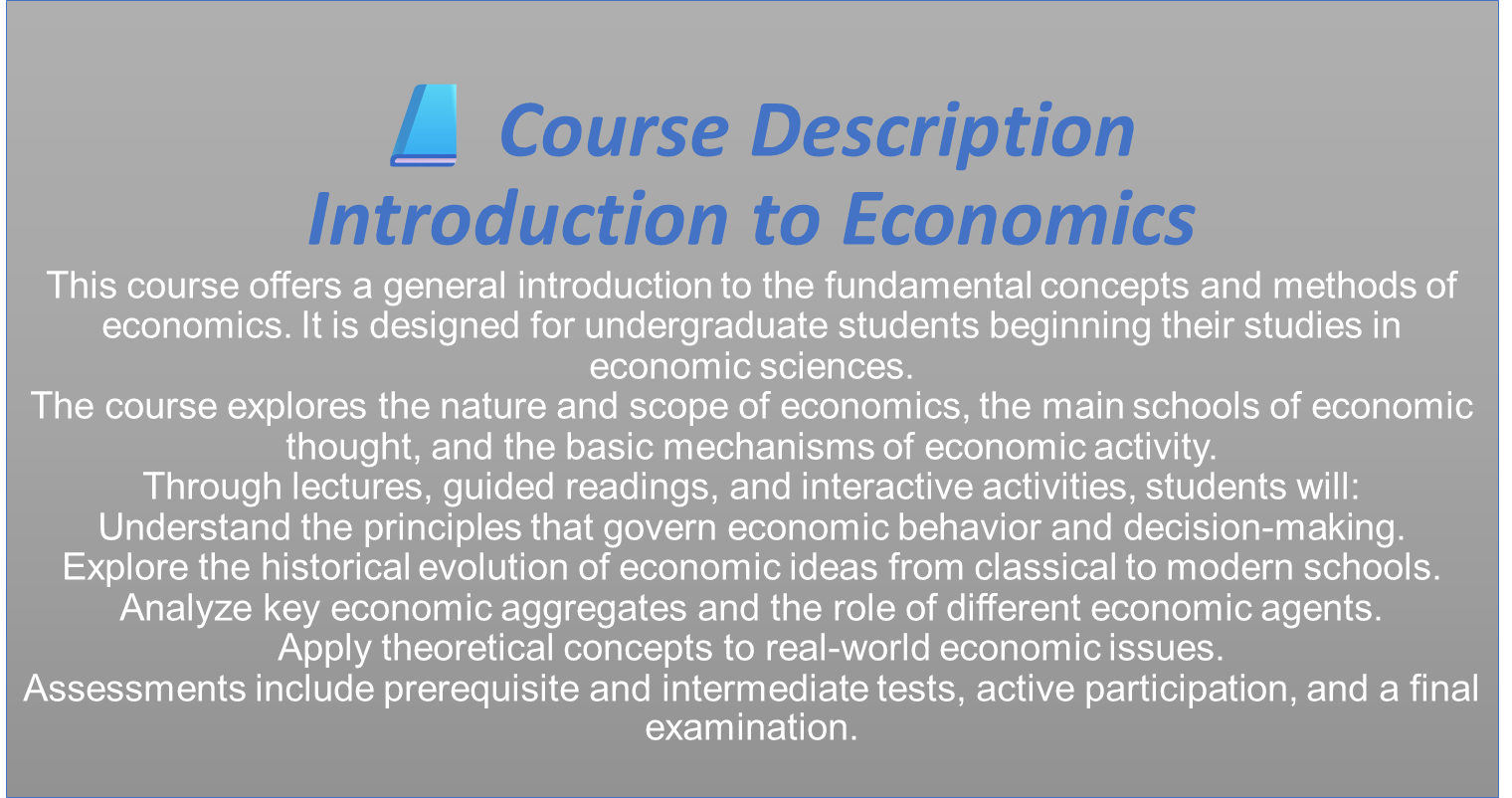
This is a course overview for "Introduction to Economics." The course covers the basic concepts of economics, the importance of studying economic sciences, and the epistemological and scientific foundations of economics. It also aims to enhance learners' understanding of the history of economic thought and activities, as well as the relationship of economics with other social sciences. The course is taught by Dr. NOUI Rabah and includes exams, tests, assignments, and reading summaries for evaluation. There is also a discussion forum for questions and mandatory test participation. The course is divided into multiple sections, including chapters one and two...
-
-

-
Opened: Wednesday, 27 November 2024, 11:40 PMClosed: Sunday, 1 December 2024, 11:40 PM
A prerequisite test is an assessment designed to verify whether students or participants have the basic knowledge or skills necessary to take an introduction to economics course.
-
-
-

-
Welcome to the General Discussion Forum. This is a space for students to ask questions, share ideas, and exchange resources related to the course. Please feel free to:
-
Ask for clarification about lectures or readings.
-
Discuss methodological issues regarding your mini-research project.
-
Share useful articles, videos, or tools.
Guidelines:
-
Be respectful and constructive in your comments.
-
Use clear titles for your discussion threads.
-
Check if your question has already been answered before posting.
-
-
-
-
-
-
-
this space is dedicated to L1 students to ask their questions, interact, and discuss the different elements covered in the introductory economics course.
-
This chat room is designed for real-time discussions. The instructor will be available every Wednesday from 6 pm to 7 pm to answer questions related to the mini-research project. You may also use this space to interact informally with your peers.
-
-
-
Champeyrache, C. (2019). Introduction générale à l’économie. L1 S1. Microéconomie-Macroéconomie. Éditions LMD.https://www.eknos.fr/accueil/12495/produit/-introduction-generale-a-l-economie-l1-s1-microeconomimacroeconomie-9782340071384.html
-
De Montbrial, T., & Fauchart-Foray, E. (2018). Introduction à l’économie : Microéconomie, macroéconomie (6ᵉ éd.). Dunod.https://www.dunod.com/entreprise-et-economie/introduction-economie-microeconomie-macroeconomie
-
Collectif Dunod. (2022). Apprendre l’économie (2ᵉ éd.). Dunod.https://www.dunod.com/apprendre-economie-un-manuel-clair-actuel-et-essentiel
-
Hachette Éducation. (2019). Fondamentaux – Économie politique 1 : Économie descriptive et comptabilité (10ᵉ éd.). Hachette Éducation.https://www.enseignants.hachette-education.com/livres/fondamentaux-economie-politique-1-economie-descriptive-comptabilite-10-e-edition-9782017196860
-
Mankiw, N. G. (2020). Principles of economics (9ᵉ ed.). Cengage Learning.https://en.wikipedia.org/wiki/Principles_of_Economics_(Mankiw_book)
-
Case, K. E., Fair, R. C., & Oster, S. M. (2019). Principles of economics (Global ed.). Pearson.https://www.amazon.fr/Principles-Economics-Global-Karl-Case/dp/1292294698
-
Komlos, J. (2021). Foundations of real-world economics: What every economics student needs to know (3ᵉ ed.). Routledge. https://www.routledge.com/Foundations-of-Real-World-Economics-What-Every-Economics-Student-Needs-to-Know/Komlos/p/book/9781032001722
-